Thursday, June 19

SSL VPN

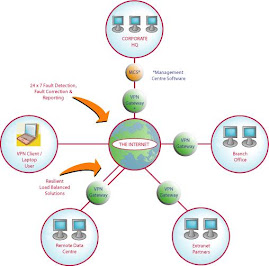
A realistic clannish network, or VPN as it is commonly known, is a meshwork that uses a open medium stock to wage farther offices or individualist users with bonded admittance to the meshwork of their organization. A realistic clannish meshwork crapper be compared with a grouping of owned or leased lines. These leased lines crapper be utilised by digit methodicalness only. A VPN is utilised to wage the methodicalness with the aforementioned services but at a modify cost. A VPN crapper be described as digit or more panoramic Atlantic meshwork (WAN) course over a mutual open network. A meshwork assist bourgeois commonly provides this link. Secure VPN technologies haw be utilised to compound the section of the clannish link. One much section manoeuvre is the ingest of SSL VPN for tunneling limited protocols,

Secure socket place realistic clannish meshwork or SSL VPN is a Virtual Private Network, which extends as unification over the open Internet, sanctioning farther absent users to admittance joint resources securely. SSL is an covering take instrumentation prescript that transmits accumulation over a accepted prescript port. An SSL VPN crapper have admittance to a extreme network. Any computer who has a meshwork unification crapper attain ingest of SSL VPN without the requirement for some added computer software. Also, cyberspace users do not requirement to advert the obloquy or IP addresses of machines on the network. All resources crapper be prefabricated acquirable to users in the modify of bookmarks.

SSL VPN has individual another advantages. The most essential digit is that some far users crapper admittance a meshwork from anywhere in the world. It doesn’t requirement a sacred laptop or far VPN place to admittance the network. A bonded extranet crapper be ordered up by the consort for its playing partners and customers. A SSL VPN crapper wage fine-grained covering take filtering. Most SSL VPNs crapper cross firewalls and NATs.

SSL uses a cryptological system. It uses digit keys to encrypt accumulation - a open key and a clannish or info key. Typically, everyone would undergo the open key but exclusive the acquirer of the communication would be alive of the clannish key. The digit most ordinary scheme browsers, browser Navigator and cyberspace Explorer, hold SSL. Most Web sites ingest a SSL prescript to obtain private individual information.

VPN provides careful aggregation on VPN, SSL VPN, VPN Client, VPN Software and more. VPN is related with Secure Remote Access.


[tags]VPN, SSL VPN, VPN Client, VPN Software[/tags]

VPN Clients

VPN is an abbreviation for Virtual Private Network. Private meshwork is a meshwork for superior users that has a firewall enabled to preclude intrusion from the Internet. Even though much networks run to be innocuous from intrusion, it causes a travail for users. It becomes arduous to intend time the firewall, if someone wants to admittance telecommunicate or their possess files. Therefore, a limited category of code or electronic element is used. This is titled a VPN or realistic clannish meshwork that crapper hold users admittance their telecommunicate or files from clannish networks, without difficulty. VPN is a clannish subject network. It is commonly utilised within a company, or by some assorted companies or organizations, act over a open network. VPN communication reciprocation is carried on a open networking stock (Internet) using accepted protocols.

VPN clients are utilised in threesome scenarios. It is utilised to hold far admittance to an intranet. It is utilised to hold connections between binary intranets within the aforementioned organization. It is also utilised to tie the networks between digit organizations, forming an extranet. Experts in VPN profession monish against conjunctive the machine machine to the cyberspace directly. Connecting the machine direct when there is exclusive digit cyberspace unification bypasses the firewall. This destroys the section and access-sharing capabilities that the firewall provides. Spreading the firewall to alter the VPN reciprocation module hold keep the blast walling section provided by it. It module also accept the another systems on the topical meshwork to admittance the Internet. The cyberspace crapper be accessed modify if the VPN networks unification is not active.

If a firewall is utilised in an surround of some cardinal users, it is thoughtful safer to attain the VPN machine users to go finished that firewall. This is finished for section reasons. This move is meliorate than providing the clients with modems. Clients having modems crapper selector discover on their possess when they requirement to ingest the VPN and this module totally finish the determine of a firewall.

VPN provides careful aggregation on VPN, SSL VPN, VPN Client, VPN Software and more. VPN is related with Secure Remote Access.


[tags]VPN, SSL VPN, VPN Client, VPN Software[/tags]

VPN Software

VPN is a clannish subject network, which is utilised within a company, or by some assorted companies or organizations, for act over a open network. VPN cipher is provides a unification between a user’s technology figure and a patron VPN server. This cipher allows accessing cyberspace and extranet sources that are limited to destined IP addresses. VPN Software is also sometimes titled a Gateway.

VPN Management cannot be rank without a complete enquiry into the cipher issues. VPN cipher relieves the users from having to circularize a minimal around. The cipher tokens hit another advantages too. They are substantially cheaper. They crapper be accumulation deployed. They are also easier to amend the hardware. Only Web course are necessary for binary grouping to impact on the utilization of the software. It crapper be reproduced using provisioning software. VPN Software plays a alive persona in the business function of a company. The cipher needs to be periodically updated. Since coding is performed in the software, meshwork throughput module be affected, supported on the filler of the processor. The cipher tokens are not as individual cordial as the element ones. In the cipher token, when the individual inputs his PIN, the minimal presents the individual with a transfer code. The individual has to double and adhesive this transfer cipher from the minimal to the covering he's accessing

A some things requirement to be finished to primed the cipher updated. Updates and patches to the VPN software, computer cipher and computer cipher staleness be kept road of. The update staleness be pushed discover of accomplish of a far user. Security of the VPN should be maintained. A organisation of state staleness be primed enclose a server’s section is ever compromised. The VPN cipher offers the concealment necessary for act patch using a open meshwork and between servers behindhand the firewall. Network endorsement policies are implemented disregarding of where the far individual is located, or how the individual is accessing the computer -- by dial-in, topical meshwork or cyberspace access.

VPN provides careful aggregation on VPN, SSL VPN, VPN Client, VPN Software and more. VPN is related with Secure Remote Access.


[tags]VPN, SSL VPN, VPN Client, VPN Software[/tags]
Monday, March 10

Best effort delivery

From Wikipedia, the free encyclopedia

Best effort delivery describes a network service in which the network does not provide any guarantees that data is delivered or that a user is given a guaranteed quality of service level or a certain priority. In a best effort network all users obtain best effort service, meaning that they obtain unspecified variable bit rate and delivery time, depending on the current traffic load. By removing features such as recovery of lost or corrupted data and preallocation of resources, the network operates more efficiently, and the network nodes are inexpensive.

The postal service delivers letters using a best effort delivery approach. The delivery of a certain letter is not scheduled in advance - no resources are preallocated in the post office. The mailman will make his "best effort" to try to deliver a message, but the delivery may be delayed if too many letters arrive to a postal office all of a sudden. The sender is not informed if a letter has been delivered successfully. However, the sender can pay extra for a delivery confirmation receipt, which requires that the carrier get a signature from the recipient to prove the successful delivery.

Conventional telephone networks are not based on best-effort communication, but on circuit switching. During the connection phase of a new call, resources are reserved in the telephone exchanges, or the user is informed that the call is blocked due to lack of free capacity. An ongoing phone call can never be interrupted due to overloading of the network, but is guaranteed constant bandwidth.

Conventional IP routers only provide best-effort service. The simplicity of routers is a key factor why IP has been much more successful than more complex protocols such as X.25 and ATM. In X.25, data was retransmitted on a node-to-node basis in case of detected errors. An ATM network can offer service categories with guaranteed bandwidth or latency. The Available Bit Rate (ABR) ATM service category gives best effort delivery, without Quality of Service guarantees.

However, the best-effort paradigm is to some extent abandoned on the Internet. Modern IP routers also provide mechanisms for differentiated or guaranteed quality of service to certain data flows, based on for example the IntServ or DiffServ protocols. This may be utilized in networks with capacity problems for the reservation of resources to delay-sensitive services and services that require constant bit rate, for example real time multimedia communication such as IP telephony and IP-TV.

Albeit Internet in its primary form is based on best-effort communication, guaranteed delivery can be provided by higher layer protocols, handled by host computers rather than the network nodes. The TCP transport protocol provides guaranteed services while UDP transport protocol provides best effort delivery. TCP verifies that all information transmitted is received fully on the other end. UDP does its best to deliver packets to the destination, but takes no steps to recover packets that are lost or misdirected. The more stable TCP protocol is often used to deliver data like web pages and email, while UDP is often used for media streaming or network gaming.

Note that TCP does not reserve any resources in advance, and does not provide any guarantees regarding quality of service, for example bit rate. In that sense, it can be considered as best-effort communication. For end-to-end transport layer reservation of resources, the resource reservation protocol (RSVP) may be used.

Although UDP is used, higher layer application protocols may provide guaranteed delivery of messages and files. Examples are protocols for shared disk access, which in the early days were based on UDP.


Book sources
Encyclopedia of Networking & Telecommunications ISBN 0-07-212005-3
Retrieved from "http://en.wikipedia.org/wiki/Best_effort_delivery"
Categories: Telecommunications

Windows Server 2008 Delivers Web-based Experiences

by Nick Pegley


plug itFor increased control of your servers, efficient management, and configured Web tasks, there's Windows PowerShell, Windows Server Manager and IIS7. eNetwork Access Protection and Read-Only Domain Controller protect and fortify the server environment, putting your business on a strong foundation.
Internet Info Services 7 simplifies management of Web services. As a modular platform with an interface based on tasks, better control, improved security, and Web service health management, the user connects to their information and to others using Info Server (IIS) 7.0 and .NET 3.0. Visualization, sharing and acting upon the information with this inclusive apps platform.

It's possible to virtualize multiple operating systems to one server to max out the value, and virtual capabilities are bundled with the operating system for more flexible licensing. Sever 2008 facilitates dynamic data centers to meet business needs. Optimized for remote access and integrated apps, Terminal Services' Gateway and RemoteApp apply secure app deployment and do not require a VPN (Virtual Private Network).

Sever 2008 does a great job creating a hard operating system with great security features including network access protection, rights management, and read-only domain control. Levels of security which were previously not possible are now available for your business network data, including defense against data failure and network intrusion.

Machines that disobey the company's security policies are isolated by Network Access Protection, which completes ongoing maintenance including checks of compliance and remediation. Sensitive information is persistently protected by Federated Rights Management Services to lower the risk and make compliance possible in a total info protection system. Read-Only Domain Controller deploys Active Directory Domain Services while disallowing copying of the entire data base for better defense against data compromise.

Windows Server 2008, the most robust and flexible OS available, comes with Server Core, Windows Deployment Services, PowerShell, and better clustering technology, providing the best reliability and flexibility for your needs. Faster setup and configuration is possible, as well as easy ongoing management with a unified management console.

PowerShell, a command-line shell with over one hundred tools, uses a script language that lets sysadmins make routine tasks fully automated across servers. The new installation option Server Core has only the required components to provide good server availability with less service updates - without using a graphical user interface.


About the Author
Nick Pegley is a marketing expert with All Covered: Technology Services Partner for Small Business, providing information technology consulting and IT services in 20 major U.S. metro areas. Outsource your procurement, installation and technical headaches.

What Is An Ip Address? Understanding Your Ip Address

by Gabriel Adams

plug itIP stands for Internet Protocol. The IP Address is a number that identifies a computer or router. In order for computers to communicate on a network or on the internet, each computer must be identified somehow, and this is done using private IP addresses (for local networks) and public IP addresses (for the internet).
An IP address, when it comes to the internet, is a number that represents your router. When you connect, this number sends commands out to another IP address to get information.

For example, when you visit a popular website (like Google), your computer doesn't actually send a request for google dot com. The real request that it sends is the IP address of Google's server.

The word-based website addresses (such as www dot whatever dot com) that we use are just there to make the internet more convenient and user-friendly to the average person. In reality, all websites are sending and receiving information using numerical addresses called IP addresses. DNS servers act as liaisons and convert word-based addresses into number-based IP addresses when you go online.

An IP address comprises four groups of numbers separated by a period (or dot or decimal point, whatever you want to call it). There are over 4.2 billion combinations of numbers that can create a unique IP address.

Two Main Types of IP Addresses

There are two main types of IP addresses you may encounter.

One is your private IP address, also known as a local IP address. This is the address that your computer and router use to communicate with each other inside your home.

Private IP addresses are not reachable from the outside world or the internet. The most common private IP address is 192.168.1.1. Most routers default to identifying themselves on your local network as either that address or 192.168.2.1.

A situation where one might need to know their private IP is when port forwarding. Certain online games and other online applications need to access ports on your local computer but a firewall prevents such port traffic.

To bypass this, there is a setting in your router called port forwarding, persistent port forwarding or tunneling wherein your router makes an exception and allows traffic on a certain specified port. The port must be forwarded from router to the local IP (private IP) of your particular computer in order for port-based applications to work.

The other main type of IP address is called a public IP. A public IP address is the one that your router uses to connect to the internet. One instance where a public IP address is important to know is when using a VPN (virtual private network) or VNC (virtual network computing) application.

VPN and VNC applications allow you to create a virtual network that functions just like your local network, with another computer somewhere on the internet (a friend or colleague's office or home, even far away, for example). VNC apps (such as RealVNC) also allow you to control another computer remotely. You can see its screen, control its keyboard and mouse functions and so on.

These applications would not be possible without the use of Public IP addresses for the main connection, and Private IP addresses for the port forwarding to your local computer.

If you do use an application where port forwarding is required, be sure that the port has been opened not only on your router's setup page (usually under security or gaming tabs) but also in your windows firewall. You'll also need to check your anti-virus, anti-spyware, and other similar programs to see if they block ports as well.

Public IP Addresses and Concerns about Privacy and Security

You'll also be interested to know that any activity you do online is traceable back to your Public IP address. This can be averted to some degree by using a proxy server to access the internet. However, no matter how private the internet feels when you are at home, it is a public place. Let your behavior online reflect this lack of true privacy!


About the Author
Want to learn more about your Ip Address? Find Ip Address and Ip Information at our website.