Sunday, August 3

Free ISP?

Yes, there is such a thing as a free ISP or internet service provider. An internet service provider is a company that provides internet access, usually for a nominal fee. However, you might be surprised to find that there are Free ISP?s. If you are wondering if I am referring to the discs you receive in the mail that offer you free internet for 30 days, think again. The ISP?s I am talking about are not offering just a free trial.

So, how are these ISP?s able to offer free internet access? The answer to that will not come as a surprise. In fact, advertising is the funding source behind many free products. For instance, you can find many sites offering free MP3 downloads. However, just like the free ISP?s, these sites come with a great number of pop-up advertisements. In fact, these pop-ups can be so numerous on free internet connections offered by these ISP?s that it can become a real nuisance. It may even stall your computer and make it difficult and frustrating to surf the net.

Additionally, these free ISP?s may not offer internet, or free internet, in your area. If there is not a dialup number in your area, you may have to go without. These ISP?s may also limit the amount of time you can spend surfing the net. The amount of features that commercial ISP?s include may be lost when going with a free ISP. Most ISP?s that charge for their services are constantly coming up with new features. This is not the case with ISP?s that offer free internet services. Free ISP?s may also provide a poor quality connection with more interruptions that commercial ISP?s.

If you are looking for an ISP that is a step up from the free ISP?s, the answer might be right in front of you. You see, a lot of ISP?s that offer free internet services also have a premium package available for a low cost. In fact, offering free internet access can be a way for these ISP?s to attract customers. Once a customer sees that they enjoy using the ISP, they may decide to purchase unlimited access from them rather than their competitors.

Before accepting the terms and conditions of your ISP, always be sure you have read and understand every thing. When you are agreeing to free internet access you want to make especially sure that your ISP is truly offering the free internet access you think they are. You also want to make sure you know how much your internet time is limited to, if that is the case. You also want to look for any additional charges or long distance charges that may apply for your ISP.

About The Author:

Neil Shevlin is the owner of UK Cheap Broadband which is a great place to find broadband links, resources and articles.

For more information go to: UK Cheap Broadband

http://www.ukcheapbroadband ? Copyright 2005

Please feel free to copy and paste this article and it's resource information.

Saturday, August 2

Broadband Telephony Gains Popularity

In the coming years, a majority of UK?s population is expected to dispose off their traditional landline phones in favour of broadband telephony which offers cheap calls.

Broadband telephony is gaining popularity as consumers are becoming increasingly aware of this technology. Analysts Gartner say that by 2009, 70% of voice calls will be wireless as a result of slashing mobile prices.

Since Internet telephony does not work with dial-up Internet access, you may see more people switch from dial-up to broadband Internet access as its popularity increases.

The cost of handsets may fall down to ?14 by 2010. The companies providing software for broadband telephony via PC are also gaining popularity among consumers but it is predicted that in due course, VoIP-enabled telephones will win out. Although lots of people have downloaded the software for broadband telephony, but not all of them use it.

The conventional telephone companies are affected by the growing popularity of broadband telephony in both a good and bad way. Although they are adopting this technology, the lower prices of VOIP do not mean that they will gain the same amount of revenue as they did from their traditional telephone services in the past. It has been estimated that there will be three billion mobile subscribers in the world by 2010.

Fixed line operators are now incorporating wireless with their traditional phone services providing ease of having one device and one bill for both mobile and fixed line calls. But the constant slashing of VOIP prices will discourage people to continue with their landlines alone. People are expected to use mobile phones instead of landlines if the mobile prices continue to fall.

Webmaster

UK mobile phone directory

What is a Virtual Private Network?

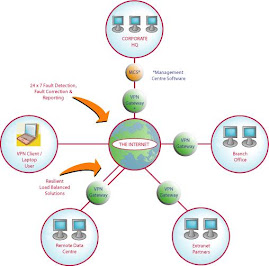
A Virtual Private Network, or VPN, is a way of using the Internet to provide remote users with secure access to their network. Data is scrambled as it?s sent through the Internet ensuring privacy. In other words a business which may be located in New York can use the company?s network to send encrypted information to different branches of the business located in other parts of the country.

Information doesn?t have to be sent office to office either. An individual choosing to work at home can have all of the same amenities (programs, email, etc) as working in the office, thanks to a VPN. Because all data is scrambled prior to being sent, and decrypted once it reaches its destination, there?s no fear of interception since only authorized users can view the information.

With a VPN, data is carried over the Internet through a process called tunneling. Tunneling is when a package is placed within another package before it?s encrypted and sent to its destination. The path in which the packet travels is called a tunnel.

A firewall can be set up to prevent a barrier between a private network and the Internet. The firewall can be set up to only accept certain information and also reject packets containing unwanted information. For purposes of security, the firewall should be set up prior to installing a VPN.

The Benefits of a VPN are:

-Increased Productivity
-Improved Security
-Lower operational costs
-Simplified Network Topology
-Opportunities for Global Networking

While there are plenty of pros to setting up and using a Virtual Private Network, there?s also a con or two. For instance, someone with in-depth knowledge of network security and dealing with VPNs will have to be on staff or specialized training will be required to ensure things run smoothly. Also, different vendors might provide different technologies so not all networks may be compatible. For sure there are kinks to be worked out. Once they are however, it would be worth it to look into Virtual Private Networking for your business - especially if the benefits outweigh the risks.

James Hunt has spent 15 years as a professional writer and researcher covering stories that cover a whole spectrum of interest. Read more at http://www.vpn-guide.info

Friday, August 1

Evaluating Bandwidth Choices Frame Relay vs VPN

Looking for bandwidth? That can be a daunting and frustrating task even in the best of situations. There's lots to consider in order to make the right decision for your needs. Below you'll find some help when evaluating Frame Relay vs VPN. Factors covered include Technology, Speed, Description, Application, Pros, Cons, and Costs.

~~~~~~~~~

Technology: Frame Relay

Speed: 56 Kbps - 1.544 Mbps

Description: A high-speed, packet based, data transmission service used in wide area networks (WANs) to connect multiple locations.

Application: Used to connect multiple locations to a main location or to each other.

Pros: Cheaper alternative to private line connections. Ability to burst when needed. Widely available.

Cons: Up-front equipment cost can be prohibitive.

Costs: Frame relay monthly cost starts at around a few $100 per location for a stable, reliable system. Price climbs as speed increases. However....the pricing for these connections varies widely depending on the carrier, location of service and the application for which the connection is being used.

~~~~~~~~~~

Technology: VPN

Speed: 56 Kbps - 1.544 Mbps

Description: VPN is a software-defined network that runs over a shared public network and offers the appearance, functionality and usefulness of a dedicated private network, at a price savings.

Application: A highly flexible method of communicating between locations via a secure tunnel on a large public network. Is becoming an increasingly popular alternative to Frame Relay and Private Line.

Pros: A user can access the network from any Internet connection. VPNs often cost less and are more flexible and scaleable than competing technologies.

Cons: The availability and performance of a company's WAN is largely dependant on factors outside of their control.

Costs: VPN prices mirror that of dial-up or dedicated Internet Access. Cost of the VPN tunneling and encrypting is nominal. Expect to spend a few $100 at least for a stable, reliable system.

Michael is the owner of FreedomFire Communications....including DS3-Bandwidth.com and Business-VoIP-Solution.com. Michael also authors Broadband Nation where you're always welcome to drop in and catch up on the latest BroadBand news, tips, insights, and ramblings for the masses.

VPN Overview of Virtual Private Networks

Virtual Private Network is a network within a network. This is very popular with businesses that have people working remotely. Basically what we have here is a utilization of the network already provided by the internet. The internet infrastructure can be used as the network for remote employees to access their corporate systems.

Corporate environments have a far greater need for tight security. This is achieved by creating a VPN (virtual private network) on top of the normal internet connection. This type of connection allows for greater security and encryption. Only authenticated users can access the corporate network and the data being transferred cannot be intercepted.

So this VPN (virtual private network) connection is being run through the internet public network.

Two components are needed to make this scenario work. First, there needs to be a corporate server setup which has the server VPN software installed (and a good router with a firewall). The next would be to have the client VPN software installed on the remote employees machines. Once the client machine is on the internet, they would use the VPN client software to communicate to the corporate server VPN where authentication occurs. Once the server identifies the connecting client as a valid machine, access to the network is granted. From then on all information to/from the client to the server is traveling along this virtual private network and is protected by the additional layer of encryption and security provided.

Finally, there can be a cost savings if determining whether a leased line or VPN is for you. Leased lines can increase in price based on the geographic distance between sites. A virtual private network does not and in fact is more scaleable. (This is a general statement ONLY. It's best to consult with your communications broker prior to making this decision. A broker will be able to provide much more information when compared to speaking with a specific vendor)

VPN is definitely a viable option for businesses small and large that have remote employees, need site-to-site access with remote offices or secure dial-up connections.

This article is just a very general overview. You should use this only as a starting point to even determine whether or not this type of technology is for you. During your evaluation of this technology, you should consider what type of implementation your looking to do; remote access, site-to-site, secure dial-up. Additional areas to research would be security, firewalls, encryption, server type and IPSec (internet protocol security protocol).

Michael Weaver - http://www.fullservice-broadband-provider.com

The full service broadband provider is a service offered by Try Right Technology, Inc. This service provides unbiased informative information on broadband technology as well as local/long distance and cellular service. Copyright 2005

The Wide Area Network Dilemma

I recently attended a trade show aimed at owners and operators of convenience stores. Dynamic speakers at the show inspired many attendees to ask lots of thoughtful questions. As I stood in our booth talking to these business owners a theme developed: Should we network our stores? And if so, what is the best solution for our business?

Wide Area Networks (WANs) can often be the technology investment that doubles your revenue. ---okay, maybe not double. But I've got your attention and a WAN is definitely a bottom line builder.

In fourteen years of network engineering I have orchestrated successful WAN implementations streamlining ordering, eliminating overtime expenses and reducing shrink. But does every business need a WAN? Answering six key questions ---Who, What, When, Where, Why and How (including How Much)--- is the start to finding out.

Who: Get support from all departments. Anyone who will be affected will need to be involved at some level. A WAN is a significant investment, and even if it will be used only for Point-of-Sale (POS) traffic the project will go much smoother if there is buy-in from the CEO on down. A new WAN will touch training, sales, inventory, purchasing, accounts receivable, accounts payable, IT, and everyone in between. It's better to bring them in than wish you had.

What: Choosing a hardware platform is an important decision. The wrong decision now may cost tens of thousands of dollars two years from now when you want to roll out VoIP and your hardware won't handle it. Open your eyes to the BIG picture and prepare for the future. I recommend to my clients that they should think out no more than five years. The infrastructure will be ready for a facelift at that time.

When: Just as critical as Why. Time is a balancing act. Take as much time as you can to design and implement your WAN properly. Moving too quickly will leave holes that someone (probably you) will fall into. One of my clients had tried the DIY approach before contacting me for help. He implemented his 32 point WAN too quickly and the results were catastrophic. The stores didn't have enough bandwidth to work properly and the VPN tunnels were not properly secured. He spent the majority of his time just keeping the WAN running and was not able to keep up with his day-to-day work. But, as I wrote earlier, time is a balancing act. If you take too long precious momentum is lost and it becomes easy to overlook an element of the project, such as the IP addressing scheme. I have often said, A WAN is a living, breathing creature and sometimes it has attitude!

Where: This is an interesting part of the design decisions. Certainly each store will be part of the WAN but what about corporate HQ? Maybe now is the time to co-locate your data-center in a secure, professional facility? You may benefit from inviting a choice vendor or two into the WAN (called an ExtraNet). If you have retail stores you may want to be connected to your credit card processor for faster (and potentially less expensive) transactions. The same is true for gift card processors, VoIP providers, etc.

Why: There are so many reasons. The one I hear most often is, We want to get access to the POS data for each of our stores. or, We want to start using e-mail. Other reasons may include to reviewing inventory levels, implementing a new enterprise application, providing online training to store staff, monitoring video surveillance, or adding VoIP. It is critical to explore all of the reasons well in advance. Identifying as many desired components at the front end will maximize benefits and ROI. When the time comes to design the network, each application will have its own network requirements.

How (or How Much): WANs come in different colors and flavors. Private, hosted, VPN, software based, hardware based, broadband, layer 2, and layer 3 are just a few options available. To break it down more simply consider these three options:

1. Private, Managed: This option eliminates the need to hire Remote Access Specialists or highly trained (and expensive) engineers who have experience with WAN technology. A private, managed service provider will help you architect the WAN, provide project management for the implementation, and proactively monitor the network 24/7/365 once it is turned up. This results in a fast, secure network that will not require encryption.

2. VPN, Unmanaged: This is the do-it-yourself network that can be self-managed until you hit about four or five stores. After that, it becomes unwieldy to manage and remember multiple broadband providers. You will need to have someone (or a team of technicians) who can travel to the stores and install the equipment as well as (regularly) maintain the firewall security and perform firmware updates.

3. VPN, Managed: In this scenario mission critical data travels over the public Internet between the store and the corporate office. A hardware device (or software) at each end goes through the process of building a tunnel between the stores and the data center. Then each device encrypts the data packets on one end, and decrypts them on the other. Keeping the VPN Tunnel up is intensive enough. Add on to that the hard work of encryption and decryption and you will experience high latency and network outages when the tunnel drops.

The marketplace is rife with WAN providers. This has led to phenomenal competition. Competition leads to innovation (another reason to only build for a five year period). Some of the newest players (2000 to present) bring the best value to their customers. The tier 1 providers are, of course, still there. Smaller, more agile companies may provide the flexibility you need. How much you invest needs to be in direct proportion to the service you receive. Find a company that wants to help you be successful. Have at least two meetings with a company before you start to discuss the How Much question. It is absolutely essential that you both understand what will be needed in terms of bandwidth, uptime, monitoring, redundancy, billing, and other services. Remember, this is an investment to increase revenue. But David, how can that be?, you ask. Consider this:

Fraud, theft, Inventory shrink are all losses we would like to eliminate. Your new WAN will allow for immediate access to POS transactions, current inventory levels, and make catching the till dipper red-handed, adding thousands to your bottom line. Video surveillance will also help catch the nighttime burglar, not to mention the rogue employee that has inventory going out the back door. The entire world is quickly moving toward Voice over Internet Protocol (VoIP) and for good reason. Site-to-site calls are free! Site to Corporate calls are free! Long distance charges can be eliminated! Sending credit card and gift card transactions over the WAN will reduce the processing time from 30 - 40 seconds down to 2 - 3 seconds. Customers move quickly through the check out line and have a happier experience, bringing them back more often. Additionally, processors may lower your per-transaction fees for using a faster connection than dial-up. Creating a WAN will eliminate the need for costly phone lines. A broadband connection can share your existing fax line and you may be able to eliminate lines for ATM machines, credit card machines, and others. These add up to very real dollars being pushed straight to your bottom line.

Making the decision to design and implement a WAN is a terrific first step. Don't underestimate the amount of effort and time that will be required to make your project a success. Find a good partner in the marketplace that is like-minded and will work with you flexibly to meet and exceed your needs.

David Chambers helps clients design, build, and manage their network infrastructures. He lives in Dallas, TX with his lovely wife of four years and their two children. He may be reached at davidcchambers@gmail.com or 866-607-9468.