Monday, August 4

The Fundamentals Of OC3 Bandwidth...What It Does For Your Business

When searching for just the right bandwidth solution for critical business network applications a common choice is what's termed an OC3 circuit. An OC3 circuit works as a reliable fiber optic backbone for large networks with substantial voice/data/video traffic needs. For example....corporate headquarters phone lines (PBX and/or VoIP), company Supply Chain Management (SCM) systems, facility high security networks, Hospital medical imagery and diagnostic systems, data recovery and backup networks, video conferencing facilities, multi-media or virtual design centers, and ISP backbones.

OC3 is the abbreviated term for Optical Carrier level 3, and is used to specify the speed level of fiber optic networks over SONET. The speed itself is measured through SONET (Synchronous Optical Network) standards.

Specificly, the Synchronous Optical Network (SONET) includes a set of signal rate multiples for transmitting digital signals on optical fiber. OC stands for Optical Carrier and the number following specifies the speed of the fiber optic networks conforming to the SONET standard. The base rate OC1 is 51.84 Mbps. Therefore an OC3 circuit delivers 155 Mbps.

OC3 is optical carrier (fiber) connected by equipment capable of speeds up to 155.5 Mbps......and is designed to take, synchronize, and transport data and voice at that speed of 155 Mbps reliably. Due to their potential load delivery capacity....OC3 applications are used most often by large enterprises with significant bandwidth requirements or as an ISP backbone. By definition.....an OC3 is the equivalent of 84 T1s or 3 DS3s/T3s. To put it in perspective....an OC3 circuit is capable of 2,000 simultaneous voice transmissions with each transmission carrying variable data types alongside the voice!

An important factor to consider is that OC3s can be burstable, which allows you to start small and increase your bandwidth as your needs grow. A Burstable OC3 is the ideal solution for businesses who seek ultra-fast connectivity for their Internet needs.....and don't require full OC3 load capacity just yet but may in the future. Options cover selection from 60, 70, 80, 90, 100, 120, 140, or a full 155 Mbps of service.

Fiber Optics is a technology that uses glass (or plastic) threads (fibers) to transmit data. A fiber optic cable consists of a bundle of glass threads, each of which is capable of transmitting messages modulated onto light waves.

Fiber optics has several advantages over traditional metal communication lines. They have a much greater bandwidth than metal cables. This means they can carry more data. They are also less susceptible than metal cables to interference, and they are much thinner and lighter than metal wires. This enables the data to be transmitted digitally over fiber optics rather than resorting to analog transmission.

Additionally, OC-3 is most often made up of what is called a SONET ring to maintain it's reliability (redundancy) during its high speed transmissions.

A common method of back up used with SONET ring is called a bi-directional ring topology. This bi-directional ring is a physical topology which deploys two sets of fiber strands.

The first strand for the connection is for sending and receiving. The second strand will reroute traffic from the original transmission in another direction should the first strand break or malfunction. Therefore bi-directional ring topology helps ensure constant reliability within an OC3 SONET based network.

So just what does an OC3 circuit do for your business?

With an OC3 bandwidth solution your network will deliver optimum speed and load for any large scale voice/data application requirement you have....with reliable and secure digital technology performance.

Michael is the owner of FreedomFire Communications....including DS3-Bandwidth.com and Business-VoIP-Solution.com. Michael also authors Broadband Nation where you're always welcome to drop in and catch up on the latest BroadBand news, tips, insights, and ramblings for the masses

Chatless

Are you suddenly chat-less now that Yahoo has shut down many chat sites, due to complaints? One complaint was that people where using chat rooms to lure under age kids for sex. While others say the chat rooms were used to promote underage sex. A Houston Attorney, actually filed a 10 million dollar lawsuit to put an end to that problem. Yahoo reacted on the news by shutting down thousands of chat sites and advertisers on those websites pulled the plug on their ads as well. Do not despair, today you might be chat-less but soon you will find a new home to talk to friends on the Internet. Yahoo confirmed they took the sites off the air but insists it was in the high hundreds and not thousands.

Many users are enraged that the sites were taken down, while many parents applaud Yahoo?s fast acting public relations move to remove those sites immediately. Some of the advertisers who pulled out are PepsiCo, State Farm and others. Perhaps Paris Hilton can do advertise their now for Carl?s Jr.? Yahoo does not constantly monitor the content in the chat rooms, but will close a room if it receives too many complaints.

Some sources tell us that other such chat rooms now have real language filters which set points and once those have been exceeded warnings go up and if this continues then the sites are shut down. Modern Technology and text recognition software for these things is well known in high-tech circles and military intelligence. One company began promoting its software today to alleviate the problem, they specialize in email scanning and resume artificial intelligence reading and key word scanning. Chat rooms have always been a great way to meet online, yet also considered problematic for monitoring. Think on this if you find yourself; ?Chat-less?

Lance Winslow

Sunday, August 3

Comparing High Speed Internet Promotions

Are you shopping around for high speed internet and getting totally confused? $12.95 for 6 months, or $14.95 for 3 months? Upload speeds of 128 kbps or download speeds of 768 kbps? What does kbps stand for anyway? Hopefully this article will help you make some sense of all the promotions out there.

I compared the promotions (as of May 2006) being offered by most of the primary DSL and cable modem providers in Southern California. It's hard to fit a giant Excel spreadsheet into a text article, but see if you can use the information I provide to at least try to compare apples to apples. The two main criteria I focused on are price and speed.

A few points to clear up first so you can be more educated in your choices:

kbps:kilobits per second

mbps: stands for megabits per second. A megabit is 1,000 times faster than a kilobit. So 1.5 megabits is equal to 1,500 kilobits.

download speed: The download speed is for downloading web pages, software, etc. and is what you probably use most of the time.

upload speed: The upload speed is used, for example, when you might upload photos to the internet (for instance to Snapfish or sending an attachment to an email), or if you have your own website and upload your own pages.

Since you are only downloading most of the time, high speed internet companies focus primarily on download speeds, which are invariably faster than upload speeds. You might want to focus primarily on download speeds as well, depending on your type of usage of course.

Also, the general consensus is that the typical download speed for home DSL (before all these promotions started coming out recently) is about 1.5 kbps. So it is worth a word of caution that the cheapest promotions may or may not be the best for you.

Several companies are offering very good prices for 768 kbps of download speed. I have been told that this speed is adequate for people who mainly use email and do light web surfing. So you have to think about how much you use the internet. Do you download music? Are you a web surfing addict?

One thing I'll tell you is that if I, as a computer consultant, had an internet speed of 768 kbps, I'd probably be rather unhappy. But if you're a light user, you'd probably be fine. OK, now you can read about the different offers and see for yourself:

AT& T (formerly SBC):

Their lowest promotion prices are $12.99 per month and $17.99 per month. You also have to pay a $12.95 shipping and handling fee. (And you have to pay $49.99 up front for a modem, but you get a mail-in rebate of $49.99 as well.) The $12.99 price is for download speeds of 384 kbps - 1.5 mbps. The $17.99 price is for download speeds of 1.5 - 3.0 mbps.

Those prices are good for a 1-year contract, but beware. If you don't call AT&T before the year is up (I believe they send you a letter to remind you), the price goes up to $50/month. Once you call, though, AT&T will offer you whatever promotion they have at the time. There is a $99 termination fee if you break your 1-year contract.

Summary of AT&T prices:
Lower speeds: $12.99
Faster speeds: $17.99
Other fees: $12.95 shipping and handling,
$99 termination fee.

Verizon:

This company is offering a base price of $14.95 for download speeds of up to 768 kbps and upload speeds of 128kbps. The first month is free, however there is a $19.95 shipping and activation fee. This $14.95 offer is good only if you order via the internet though (a little Catch 22 there). If you call and speak to a live person instead, it'll cost you $17.99 a month. Ha!

For heavier internet users, Verizon has another, slightly more complicated promotion. For download speeds of up to 1.5 mbps, you get the first month free. Butttttt, for the second and third months it will cost you $21.95, and $29.95 for months 4-12. (Where'd they come up with that plan?) Upload speeds are about 384 kbps.

These Verizon promotions come with one-year contracts and a $79 termination fee if you break it. You also need to call before your term is up to get decent rates for the next 12 months. (for the second offer you can stay at $29.95.)

Summary of Verizon prices:
Lower speed: $14.95
Faster speed: $21.95-$29.95
Other fees: $19.95 shipping and activation fee.
$79 early termination fee.

AOL:

AOL doesn't have its own high speed infrastructure per say. It provides AOL service but uses AT&T or Verizon to deliver it in the Southland.

The price is $25.90 per month for a one-year term. After that year, Verizon customers are still charged $25.90 per month, while the service with AT&T goes up to $29.99 per month. The speeds are generally 768 kbps for download and 128 kbps for upload. With Verizon there is a shipping and handling fee of $19.95 and a $79 early termination fee, just as if you'd went with them without AOL. AT&T (as shown above) asks for a $99 early termination fee.

Summary of AOL fees:
$25.90 for 768 kbps download speed
( for other fees see AT&T or Verizon fees.)

Earthlink:

Earthlink: This company is offering a promotion of $12.95 for the first six months in certain regions of the country, with a price of $29.95 after that. This promotion is for decent speeds: 1.5mbps for download speeds and 128 kbps for upload speeds. They also charge a $19.95 shipping fee, and $149.95 if you break your 1-year contract. (So I'd guess you'd better be sure you want to stay with them!)

Summary of Earthlink prices:
Faster speed: $12.95-$29.95
Other fees: $19.95 shipping fee,
$149.95 early termination fee.

DSL Extreme:

DSL Extreme offers a promotion of $12.95 per month for customers with SBC phone service. That promotion offers speeds ranging from 384 kbps - 1.5 mbps for download, and 128 - 384 kbps for upload. Those with Verizon can expect to pay a little more, $14.95 per month. Speeds with Verizon are 768 kbps for download and 128 kbps for upload. These prices don't include $15.43 for the shipping and handling of the modem.

As with the others, you're in for a 1-year contract. But if you renew before it expires, you can lock in the price DSL Extreme is offering returning customers at the time. That price is not yet determined:

Watch out, though. The early termination fee if you decide to end the 1-year contract is a whopping $250!

Summary of DSL Extreme prices:
Lower Speeds: $12.95-$1495
Other fees: $15.43 for shipping and handling of modem,
$250.00 early termination fee.

I also talked to a couple of companies that offer cable modem:

Comcast:

The prices for cable modem tend to be a bit higher, but the two cable companies I called offered faster speeds than the DSL promotions I looked at.

Comcast is offering a promotion of $26.95 for the first three months with download speeds of 4mbps and upload speeds of about 386 mbps. But after your honeymoon the price goes up to $45.95 if you have cable TV with them or $56.95 if you don't. One good thing - there is no contract, so that means there's no early termination fee.

You also have to either buy a cable modem at an electronics store (Comcast doesn't sell them) or rent one for $3 a month. So be sure to include that fee in your calculations!

Adelphia:

To begin with, Adelphia offers a basic package which happens to be very basic. Both its upload and download speeds are 256 kbps (kinda slow if you ask me). This package's price is $24.95 per month.

The company also offers a more reasonable package that costs $24.95 for the first three months, then goes up to $43.95. The speeds with this package are pretty fast - 4 mbps for download speeds and an upload speed of 384 mbps. As with Comcast, Adelphia's packages are month-to-month, with no contract and no termination fee. But, also like Comcast, you have to either purchase your own modem or rent one for $3. Also, you don't need to have Adelphia TV cable service to get those prices. The prices are the same for both cable TV and non-cable TV customers alike.

?2006 by Kara Glover

Feel free to reprint this article in newsletters and on websites, with resource box included. If you use this article, please send a brief message to let me know where it appeared: kara@karathecomputertutor.com

Kara Glover is a Computer Tutor and Troubleshooter. You can find her free tips, articles, and tutorials at her website: http://www.karathecomputertutor.com

Free ISP?

Yes, there is such a thing as a free ISP or internet service provider. An internet service provider is a company that provides internet access, usually for a nominal fee. However, you might be surprised to find that there are Free ISP?s. If you are wondering if I am referring to the discs you receive in the mail that offer you free internet for 30 days, think again. The ISP?s I am talking about are not offering just a free trial.

So, how are these ISP?s able to offer free internet access? The answer to that will not come as a surprise. In fact, advertising is the funding source behind many free products. For instance, you can find many sites offering free MP3 downloads. However, just like the free ISP?s, these sites come with a great number of pop-up advertisements. In fact, these pop-ups can be so numerous on free internet connections offered by these ISP?s that it can become a real nuisance. It may even stall your computer and make it difficult and frustrating to surf the net.

Additionally, these free ISP?s may not offer internet, or free internet, in your area. If there is not a dialup number in your area, you may have to go without. These ISP?s may also limit the amount of time you can spend surfing the net. The amount of features that commercial ISP?s include may be lost when going with a free ISP. Most ISP?s that charge for their services are constantly coming up with new features. This is not the case with ISP?s that offer free internet services. Free ISP?s may also provide a poor quality connection with more interruptions that commercial ISP?s.

If you are looking for an ISP that is a step up from the free ISP?s, the answer might be right in front of you. You see, a lot of ISP?s that offer free internet services also have a premium package available for a low cost. In fact, offering free internet access can be a way for these ISP?s to attract customers. Once a customer sees that they enjoy using the ISP, they may decide to purchase unlimited access from them rather than their competitors.

Before accepting the terms and conditions of your ISP, always be sure you have read and understand every thing. When you are agreeing to free internet access you want to make especially sure that your ISP is truly offering the free internet access you think they are. You also want to make sure you know how much your internet time is limited to, if that is the case. You also want to look for any additional charges or long distance charges that may apply for your ISP.

About The Author:

Neil Shevlin is the owner of UK Cheap Broadband which is a great place to find broadband links, resources and articles.

For more information go to: UK Cheap Broadband

http://www.ukcheapbroadband ? Copyright 2005

Please feel free to copy and paste this article and it's resource information.

Saturday, August 2

Broadband Telephony Gains Popularity

In the coming years, a majority of UK?s population is expected to dispose off their traditional landline phones in favour of broadband telephony which offers cheap calls.

Broadband telephony is gaining popularity as consumers are becoming increasingly aware of this technology. Analysts Gartner say that by 2009, 70% of voice calls will be wireless as a result of slashing mobile prices.

Since Internet telephony does not work with dial-up Internet access, you may see more people switch from dial-up to broadband Internet access as its popularity increases.

The cost of handsets may fall down to ?14 by 2010. The companies providing software for broadband telephony via PC are also gaining popularity among consumers but it is predicted that in due course, VoIP-enabled telephones will win out. Although lots of people have downloaded the software for broadband telephony, but not all of them use it.

The conventional telephone companies are affected by the growing popularity of broadband telephony in both a good and bad way. Although they are adopting this technology, the lower prices of VOIP do not mean that they will gain the same amount of revenue as they did from their traditional telephone services in the past. It has been estimated that there will be three billion mobile subscribers in the world by 2010.

Fixed line operators are now incorporating wireless with their traditional phone services providing ease of having one device and one bill for both mobile and fixed line calls. But the constant slashing of VOIP prices will discourage people to continue with their landlines alone. People are expected to use mobile phones instead of landlines if the mobile prices continue to fall.

Webmaster

UK mobile phone directory

What is a Virtual Private Network?

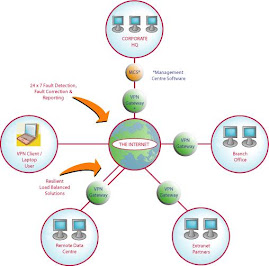
A Virtual Private Network, or VPN, is a way of using the Internet to provide remote users with secure access to their network. Data is scrambled as it?s sent through the Internet ensuring privacy. In other words a business which may be located in New York can use the company?s network to send encrypted information to different branches of the business located in other parts of the country.

Information doesn?t have to be sent office to office either. An individual choosing to work at home can have all of the same amenities (programs, email, etc) as working in the office, thanks to a VPN. Because all data is scrambled prior to being sent, and decrypted once it reaches its destination, there?s no fear of interception since only authorized users can view the information.

With a VPN, data is carried over the Internet through a process called tunneling. Tunneling is when a package is placed within another package before it?s encrypted and sent to its destination. The path in which the packet travels is called a tunnel.

A firewall can be set up to prevent a barrier between a private network and the Internet. The firewall can be set up to only accept certain information and also reject packets containing unwanted information. For purposes of security, the firewall should be set up prior to installing a VPN.

The Benefits of a VPN are:

-Increased Productivity
-Improved Security
-Lower operational costs
-Simplified Network Topology
-Opportunities for Global Networking

While there are plenty of pros to setting up and using a Virtual Private Network, there?s also a con or two. For instance, someone with in-depth knowledge of network security and dealing with VPNs will have to be on staff or specialized training will be required to ensure things run smoothly. Also, different vendors might provide different technologies so not all networks may be compatible. For sure there are kinks to be worked out. Once they are however, it would be worth it to look into Virtual Private Networking for your business - especially if the benefits outweigh the risks.

James Hunt has spent 15 years as a professional writer and researcher covering stories that cover a whole spectrum of interest. Read more at http://www.vpn-guide.info